Over the past several days, multiple violent incidents reported in the United States have attracted public attention. At first glance, they may seem connected. In some cases, witnesses reported statements referencing religion or ideology. In others, the targets themselves expressed concerns about identity-based violence. However, when analyzed through an investigative and behavioral perspective, these incidents reveal an important insight.
Violence does not develop through a single pathway. Recent events in San Jose, West Bloomfield, New York, Norfolk, and Austin reveal several distinct patterns that investigators and threat-assessment professionals are increasingly identifying. Understanding these differences is crucial because the indicators that precede violence vary by case.
The San Jose Incident: Escalation in the Moment
Police in San Jose, California, are investigating an assault that took place in the Santana Row shopping district. According to authorities, three suspects approached two men, and an altercation became physical. The suspects escaped before police arrived, and the victims received treatment at the scene for minor injuries.
The victims reported that antisemitic language was used during the confrontation, which is why investigators are considering the incident a possible hate crime. At this point, there is no public evidence that the suspects arrived with a premeditated plan to commit violence. Based on current information, the incident seems to have escalated from a confrontation. Events like this tend to happen quickly: a verbal exchange turns hostile, group dynamics develop, and physical violence ensues.
The West Bloomfield Incident: Targeted Identity Violence
A very different situation happened at Temple Israel in West Bloomfield, Michigan. Authorities said that an attacker drove a vehicle into the synagogue and was armed with a gun. Security personnel confronted the suspect, and the incident ended before anyone inside was hurt.
The location itself is important. When a religious place linked to a specific identity group becomes the target of violence, investigators often look at ideological or identity-based reasons. Targeted attacks on religious places often come from grievances related to geopolitical conflicts or ideological hatred. But confirming those reasons needs more investigation.
The New York Incident: Ideological Preparation
In New York City, federal prosecutors state that two Pennsylvania men tried to deploy improvised explosive devices during protests outside Gracie Mansion. According to the Department of Justice, investigators allege the suspects obtained materials used to make explosive devices, assembled improvised explosives, and tried to ignite and deploy those devices during a protest. Investigators also reported that the suspects expressed support for ISIS.
This case represents a different kind of threat. It involves planning, gathering materials, and attempting to deploy explosive devices in a crowded area. These elements elevate the incident from a confrontation to a planned violent attack.
The Norfolk, Virginia Incident: Resurfacing Ideological Violence
Another incident occurred at Old Dominion University, where a gunman opened fire inside a classroom connected to the university's ROTC program. Authorities identified the shooter as Mohamed Bailor Jalloh, a former Army National Guard member who had previously been convicted in federal court for attempting to support ISIS militarily. Jalloh had served several years in prison before being released in 2024 under supervised conditions.
According to investigators, Jalloh entered the classroom and opened fire, killing an ROTC instructor and injuring two others before students subdued him on the scene. The FBI stated the incident is being investigated as an act of terrorism.
This event introduces a scenario that investigators must consider carefully. Unlike attacks that happen suddenly or by individuals who radicalize quickly online, this case involves a person with a documented history of ideological extremism and previous criminal charges related to terrorism. Cases involving individuals with a history of radicalization show that the path to violence can take years. Even after incarceration or monitoring, the core grievances or ideological commitments may still endure.
The Austin Incident: Mass Casualty Environment
Another incident took place on West Sixth Street in Austin, Texas, where a gunman opened fire in a busy nightlife area. Investigators reported that the attacker used firearms in a crowded entertainment district, leading to multiple casualties. Authorities are still investigating the motivations behind the attack.
Mass-casualty shootings often happen in environments with large crowds, which increases the potential impact of the attack regardless of the motive.
What These Incidents Have in Common
Although the pathways vary, these incidents share several similarities.
All happened in places meant for open access — shopping districts, religious institutions, protests, and entertainment districts. These settings let large crowds gather freely, which, unfortunately, also opens the door for violence.
None of the incidents involved large, organized networks. Instead, they involved individuals, lone actors, or small self-directed groups. This reflects a broader shift in the modern threat environment toward individual or small-cell actors.
In several incidents, witnesses reported that attackers shouted phrases referencing religion or ideology during the attack. However, statements made during an incident alone are not enough to establish a link to terrorist groups. Investigators must verify those statements and determine whether they genuinely reflect ideological motivation or were made in the heat of the moment.
What Must Be Established to Confirm Radicalization or Terrorism
When investigators assess whether an attack is related to radicalization or a terrorist organization, several key elements must be confirmed.
Ideological Alignment — Evidence that the suspect embraced extremist ideology through writings, online communications, social media activity, or statements of allegiance.
Operational Preparation — Evidence of preparation activity, such as acquisition of weapons or explosives, research into targets, surveillance of locations, or construction of devices.
Communication With Extremist Networks — Investigators look for contact with known extremist groups, online radicalization communities, or individuals encouraging or facilitating violence.
Target Selection — The choice of target can also reveal motivation. Attacks on religious institutions, government officials, or symbolic sites may indicate ideological grievance narratives. However, target selection alone is rarely enough to confirm terrorism without additional evidence.
Predictable Patterns
What these incidents ultimately show is that violence and disruption rarely follow a single, predictable pattern. Some events stem from spontaneous confrontations and quick escalation. Others involve ideological grievances, preparation activities, and deliberate attempts to carry out attacks. In some cases, individuals or small groups also try to create disruption through cyber-enabled actions targeting infrastructure or public systems.
For investigators, security professionals, and threat-assessment teams, the key task is to identify the signs associated with each pathway before an incident occurs.
Applying the Threat Environment to Real-World Regions
Although the incidents mentioned earlier occurred in different parts of the country, they reveal patterns that investigators and security professionals are increasingly recognizing across many regions of the United States. The risk environment varies by location. Population density, infrastructure, political prominence, and public gathering habits all shape how threats develop in a specific area.
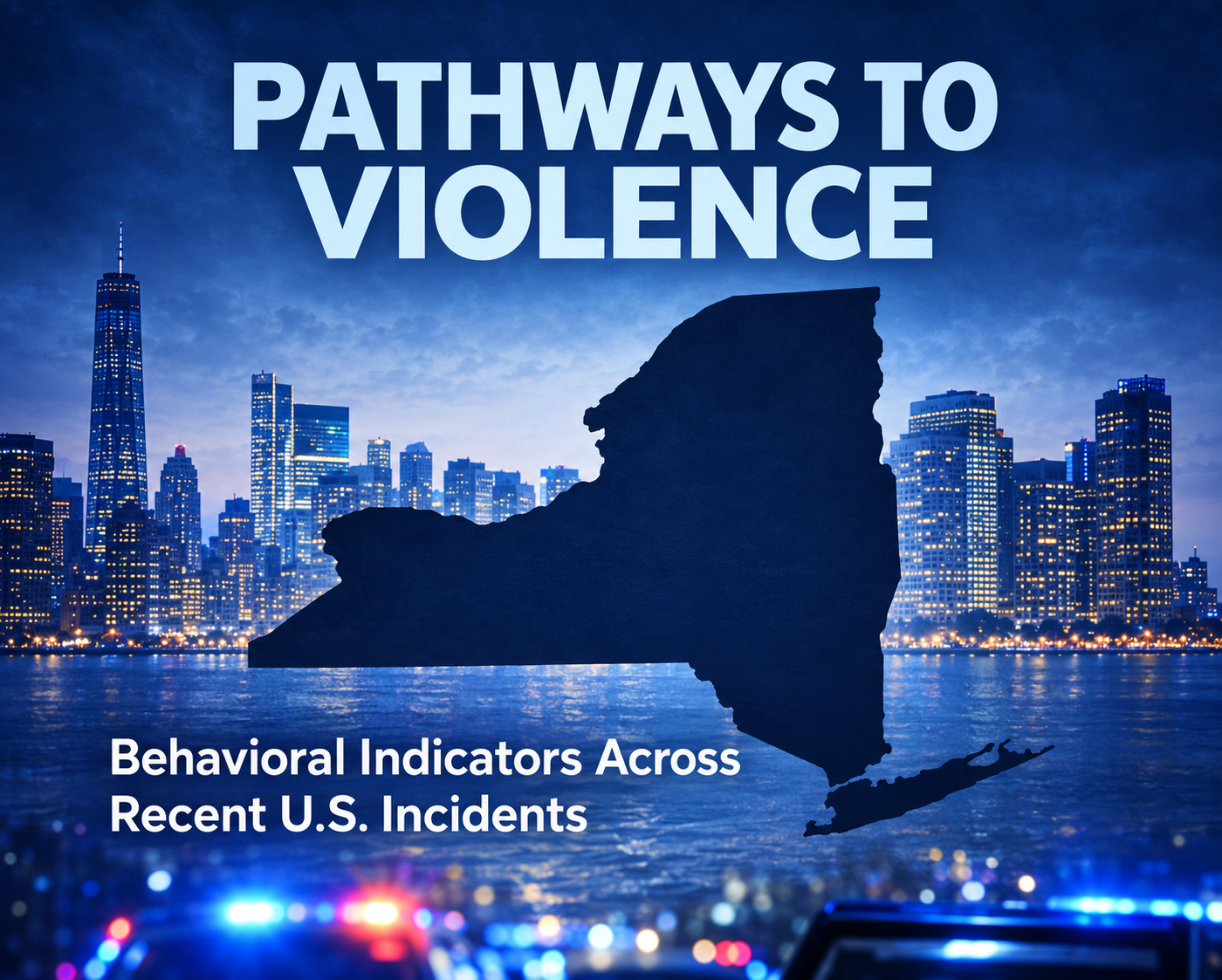
New York State exemplifies this complexity clearly. The state includes one of the world's largest metropolitan areas, essential transportation and financial infrastructure, and densely populated urban regions. At the same time, many parts of the state are made up of smaller cities, rural communities, and critical infrastructure systems that support regional services.
Soft Target Categories Requiring Elevated Awareness
Throughout New York State, certain location types frequently emerge in threat assessments.
Houses of Worship — Religious establishments continue to be among the most common targets in identity-based attacks. Protective considerations include controlled access during services, trained safety teams, collaboration with local law enforcement, and clear emergency communication plans.
Public Demonstrations and Protests — These gatherings may involve individuals driven by ideological concerns, political messages, or symbolic displays. Protective planning should account for crowd density, opposition groups, symbolic locations, and limited participant screening.
Entertainment and Nightlife Districts — Open movement, large crowds, and limited access control create environments that can attract attackers aiming for mass-casualty impact.
College Campuses — Universities combine several risk factors: large gatherings of students, protests and demonstrations, open campus environments, and frequent public events.
Cyber Infrastructure Risk Environment
Beyond physical attacks, the current threat landscape shows an increasing concern about cyber-enabled disruptions. Federal reports indicate that nation-state adversaries and ideologically aligned actors continue to target U.S. networks and critical infrastructure. State-sponsored campaigns often produce publicly visible tools, methods, or tactics that can later be adopted by sympathizers, loosely connected hacktivist groups, or individual actors.
Critical infrastructure sectors requiring attention include water and wastewater systems, energy and utilities, food and agriculture, transportation and public infrastructure, and local government systems.
Key Operational Insight
Violence and disruption in public spaces are often seen as a single type of threat. However, the causes behind these incidents can vary greatly. Some stem from personal conflicts and quick escalation. Others arise from ideological grievances, radicalization, or intentional operational plans. Increasingly, online-enabled activities also need to be viewed as part of the broader threat environment.
Recognizing these differences helps investigators, security experts, and threat-assessment teams spot warning signs earlier. Detecting these signals sooner allows for more opportunities to intervene before the situation escalates to violence.
PGI Protective Intelligence Brief
This article is accompanied by a full intelligence brief that expands on the behavioral framework discussed above and outlines indicators associated with physical and cyber threat escalation.