
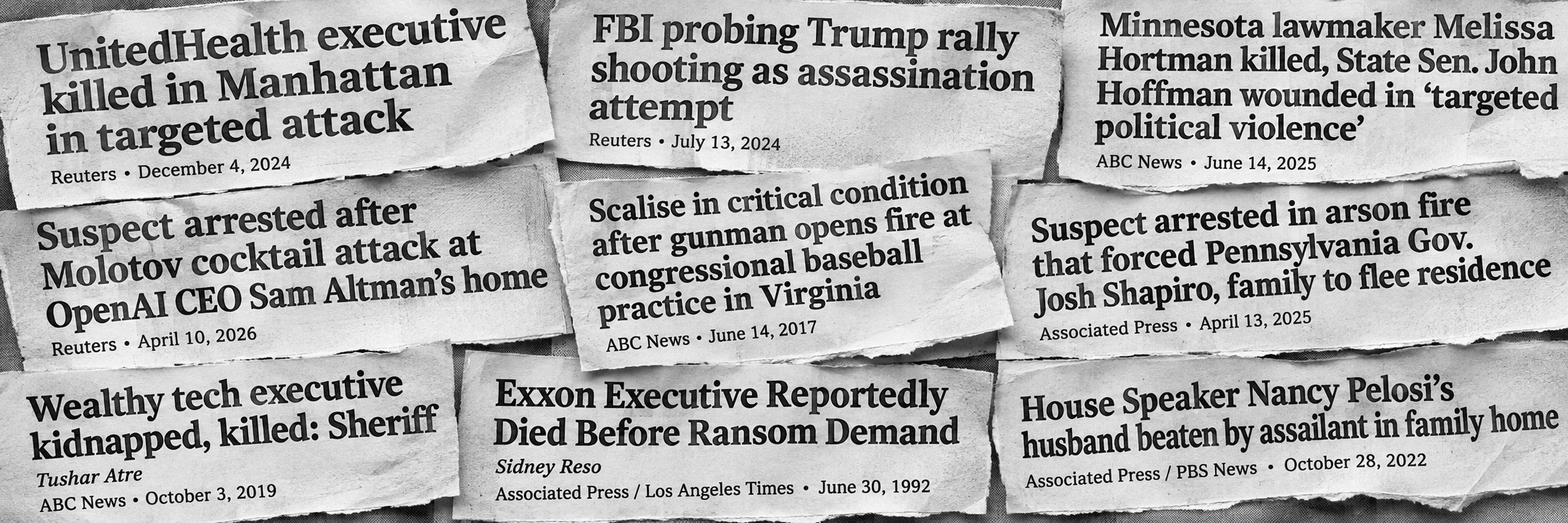
Reports of senior federal officials moving into military housing raise an understandable question: what has changed enough that someone needs to leave home for protection? For business leaders, another question is worth asking. Could the same circumstances affect an executive whose company has no military gate to move behind?
Treasury Secretary Scott Bessent said he moved to a military installation on Secret Service instructions amid Iranian threats. He also said publication of an aerial image of his residence contributed to the exposure. Reuters reported his account of the move. The detailed protective assessment remains private. [1]
The decision illustrates something every protection program should consider. An office may be secure while the person who works there remains exposed at home, with family, or while traveling. Understanding that exposure starts with familiar investigative questions: motive, means, and opportunity.
What Is Happening in Government
“U.S. Capitol Police threat assessment cases rose nearly 58% in 2025, from 9,474 to 14,938.”
Threats reach well beyond Washington. Local officials, election workers, legislative staff, and judges also report threats, harassment, and physical attacks. Many of these incidents receive little news coverage. Whether reported in a survey, documented by police, or described by the person involved, they help us understand what officials and their families are facing.
Read the Table — Reported Threats Against Public Officials
Population and source Reported findings Direction or context Congress and associated personnel — Capitol Police [2] 14,938 threat assessment cases in 2025; 9,474 in 2024. Up about 58%. Includes concerning statements, behaviors, and communications. Secret Service protectees — Director Sean Curran [3] Approximately 10,000 threats reported during 2026 through the October reporting. Threats involving full-time protectees up over 40% year over year. Federal judges — U.S. Marshals Service [4] 472 threats involving 341 distinct judges in FY2026; 562 involving 395 judges in FY2025. Recorded threats declined about 16%. Multiple threats can involve the same judge. Local elected officials — Princeton and CivicPulse [5] In Q1 2026, 39% reported harassment, 17% threats, and 1% physical attacks. Quarterly reported experiences. Not an annual incident total. Local election officials — Brennan Center [6] In its 2026 survey, 32% reported experiencing threats, harassment, or abuse, versus 38% in 2025. The reported share declined but remained substantial. Experience questions cover more than the survey year. State legislators — Brennan Center [7] 43% reported threats during their current term or preceding campaign. Survey conducted in 2023 and published in 2024; a state-level baseline.
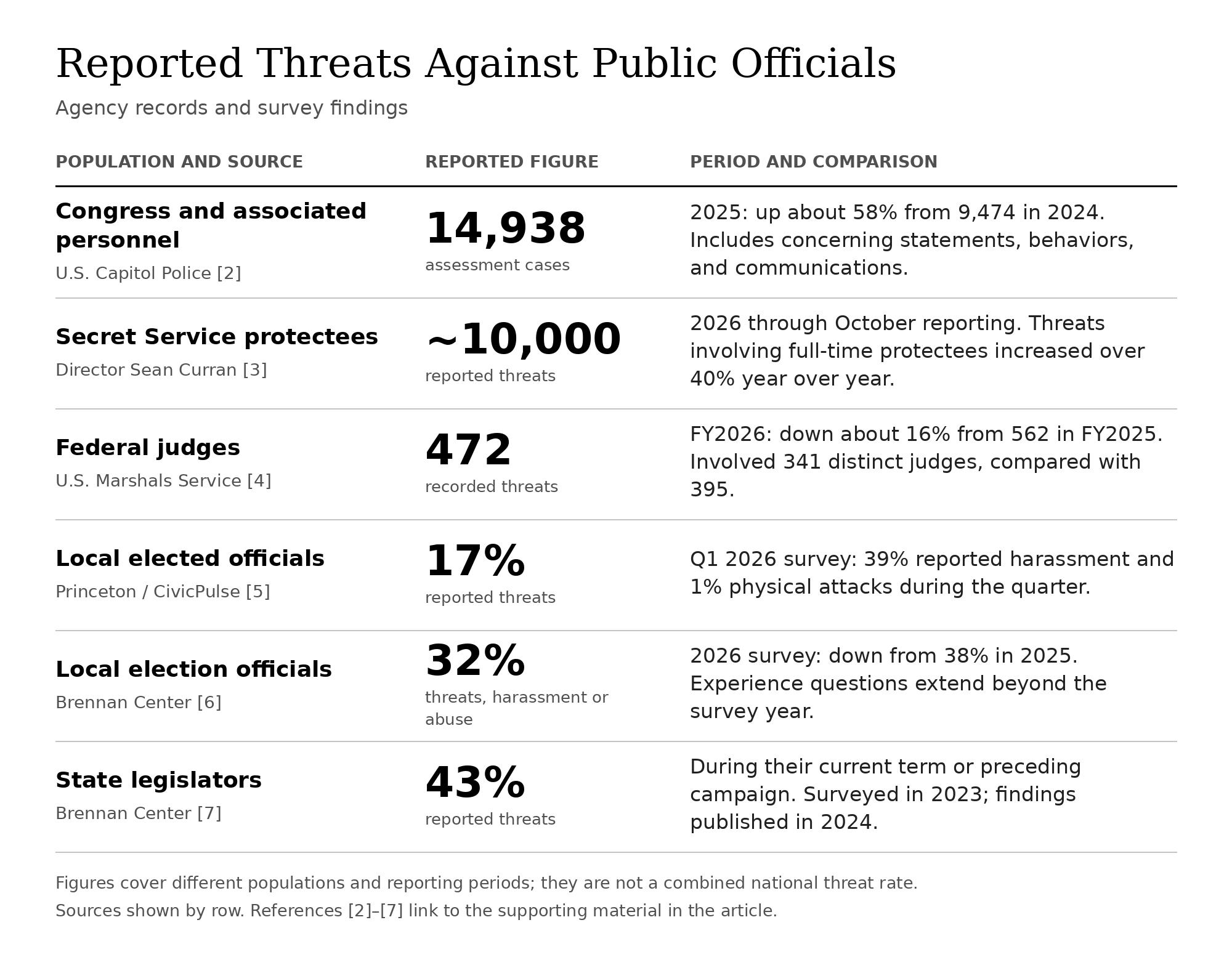
Congressional threat assessment cases rose sharply, while recorded threats against federal judges declined. The figures cover different groups and reporting periods, so each tells us something about those officials’ experiences. They cannot be combined into a single national threat rate.
What Is Happening in Business
“In a global survey, 42% of corporate security chiefs reported a significant increase in threats of violence against executives over the previous two years.”
Corporate security leaders are reporting similar concerns about threats following people beyond the workplace. Their reports provide a direct private-sector comparison, and company disclosures show how some organizations are responding.
Read the Table — Reported Threats and Corporate Protection
Source Reported findings What it tells us ASIS and Everbridge 2025 research [8] Among respondents identifying reasons for greater protection emphasis, 72% cited increased public threats and 61% increased direct threats to executives. Security professionals report threats affecting protection decisions. Allied Universal and G4S 2025 World Security Report [9] 42% of 2,352 security chiefs across 31 countries reported a significant increase in threats of violence against executives over two years. The concern extends across corporate sectors and national boundaries. The Clarity Factory 2025 CSO survey [10] 71% said their executive protection programs covered personal and business exposure; 86% included a digital component. Programs increasingly address private life and digital exposure. Pay Governance September 2026 analysis [11] Its S&P 500 review found CEO personal security disclosure prevalence rose from 35% to 54% year over year. Company disclosures increasingly include privacy services, data removal, and home network monitoring.
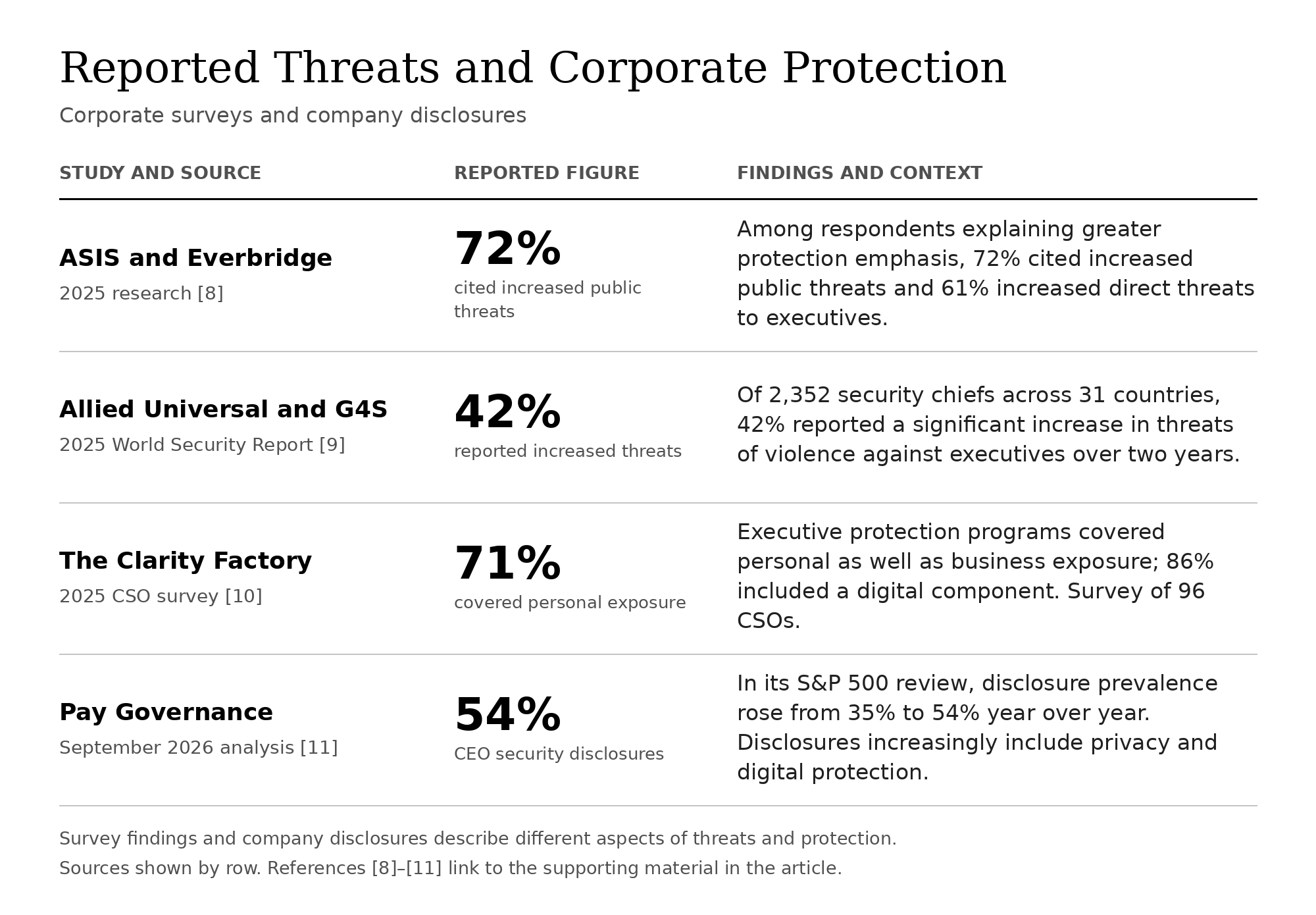
Companies are recognizing exposure beyond their facilities and making decisions about it. Protection needs to account for the executive’s private life as well as for business activity.
There are practical obstacles. In the ASIS research, 58% of security professionals cited budget constraints, and 47% cited executive noncompliance as challenges. A company may recognize a concern yet still struggle to fund the response or persuade the executive to accept it. [8]
Motive and Why a Leader Becomes the Target
A threat often begins with a grievance, though the reasons can overlap. Someone may believe an official denied a service, an employer treated them unfairly, or a company caused a financial loss. The person receiving the anger may have had little direct involvement in the original decision.
Northwestern research reported in 2026 found that most surveyed mayors identified constituents who did not understand how government works as the primary driver of threats and violence. Respondents also cited social media and partisan rhetoric as contributing factors. This helps explain why local officials can face serious hostility even without being national political figures. [12]
In business, the executive can become the scapegoat for a company decision or the symbol of an entire industry. Secret Service guidance identifies perceived wrongs, including workplace issues, as possible motives alongside ideological or political beliefs, a desire for notoriety, and other factors. The assessment should examine the person’s behavior, statements, and circumstances to understand what is driving them. [13]
Online discussion can widen the audience for a grievance and repeatedly direct attention toward an individual. In the Allied Universal and G4S survey, 75% of security chiefs said their companies had been targeted by misinformation or disinformation campaigns. We need to look at whether these campaigns are fueling hostility or putting employees at risk. [9]
Common drivers, in the public and private sectors:
- Personal grievance: an unresolved service request or disputed government decision; in business, a termination, a disputed claim, or perceived mistreatment.
- Symbolic blame: an official becomes the face of an institution or policy; an executive becomes the face of a company or industry.
- Ideological hostility: opposition to government action or a political position; opposition to corporate activities or public positions.
- Organized targeting: a foreign actor targets an official for their role; an organized actor targets leadership for coercion or financial gain.
Most people who complain or protest never become violent. But repeated accusations and hostile rhetoric can feed someone’s resentment, especially when they are already struggling with personal problems or social pressures. We become concerned when someone starts making threats, continues unwanted contact, or takes steps toward carrying out an attack. If mental health concerns are involved, we need to look at how they affect that person’s behavior. Note: Having a mental health condition does not mean someone will become violent. [12, 13]
Addressing motive also requires a planned organizational response. We recommend clear complaint channels, timely handling of disputes, staff training in de-escalation, and a reliable way to report concerning behavior. None of these guarantees a resolution, but each gives us, or an organization, an opportunity to recognize trouble and respond before contact becomes a crisis.
Means and the Market for Personal Information
Means includes having the ability and resources to carry out harm. Knowing where someone lives is one part of that. Having the physical ability, equipment, access, and resources to act on that information is another. In protection work, we need to consider both. Details about a person’s home or family can increase their exposure, even when that information is readily available online.
People-search websites gather information from public records, social media, and other companies that collect and sell personal data. They put those details together into profiles that can reveal much more than any single source. The FTC has documented how these companies buy, sell, and share information, including for marketing and fraud prevention. [14, 15]
A property record might show where someone lives, while another website identifies their spouse or children. Put together, those details make it easier to locate the person and their family. Even when the information is legally available, collecting it in one place can increase their exposure.
That exposure can also include information about where someone goes. The FTC has taken action against Gravy Analytics, Venntel, and Mobilewalla over how they collected or sold sensitive location data, including visits to military installations. These cases show that location information has been available through commercial data services. Whether it was used in a specific threat against an official or executive would need to be established separately. [16]
Why the FCRA Does Not Cover Every Personal Profile
It is reasonable to ask why access to a consumer report is restricted while other services sell detailed personal profiles. The answer lies partly in the scope of the Fair Credit Reporting Act, or FCRA. It covers more than credit scores, but it does not regulate every sale of personal information in the same way.
The law links a covered consumer report to information used, expected to be used, or collected to determine eligibility for credit, insurance, employment, and other specified purposes such as professional licensing. Its permissible-purpose rules restrict who may obtain a covered report and why. A general people-search or marketing product can fall outside that framework, depending on the facts. [17]
Does the FCRA cover only credit history?
No. Covered reports can include character, reputation, personal characteristics, and mode of living.
Can anyone buy a covered consumer report?
Access requires a permissible statutory purpose. Curiosity alone is insufficient.
Does every use require the same consent?
No. Written consumer instructions are one basis for access; other statutory purposes exist. Employment screening carries additional requirements.
Does a disclaimer create an exemption?
No. Actual activities, including collection, expected use, and marketing, matter.
Does being outside the FCRA mean anything goes?
No. Other applicable privacy and consumer protection laws can still restrict collection, disclosure, and misuse.
The FTC highlighted the disclaimer issue in its 2023 action against TruthFinder and Instant Checkmate. It alleged that the companies operated as consumer reporting agencies despite disclaimers because they marketed and sold reports for employment and tenant screening. The allegations included inadequate accuracy procedures and reports supplied without permissible purposes. [18]
The CFPB proposed a data-broker rule in December 2024 intended to apply FCRA protections to certain broker practices, then withdrew it on May 15, 2025. The proposal never became an operative rule. The existing FCRA remained in place. [19]
The resulting policy question is straightforward. “Do the rules governing personal information adequately account for the physical danger created by making someone easy to locate?” At PGI, we believe effective safeguards should address that exposure while preserving legitimate investigative uses and public access to government records.
Opportunity and the Places We Are Exposed
Opportunity concerns access. An organization may control entry to its headquarters while having much less control over an executive’s residence, public appearances, or travel. Moving a person into a more controlled setting can reduce that opportunity. The same principle applies when a company improves residential protection or temporarily relocates an executive.
At PGI, we want the people we protect to carry on with their lives with as little disruption as possible. We work to manage the space around them, whether at home, at work, or out in public, so we can recognize a concern and respond before someone gets close enough to cause harm. That takes planning and cooperation, with an understanding of when our presence helps and when we need to give them room.
Location data can show where someone lives or where they are right now. Removing a home address from a website helps, but we also need to look at which apps track their location and what they, their family, or staff share online. Otherwise, we may remove the address while leaving other ways to find them.
Where personal information appears, and what you can do:
- People-search websites: ask to have your information removed, then check periodically. Your details may remain on other sites or reappear later. [14]
- Google Street View: ask Google to blur your home. Blurring does not remove the address or images available elsewhere. [20]
- Search results: request removal of personal information or doxxing content. The information may still be on the original website. [21]
- Photos and videos: remove embedded location information and check what is visible before sharing. Buildings, signs, and other details may still identify the location. [22]
- Apps and shared accounts: review location permissions and who can see shared information. Other apps, accounts, or devices may still reveal your location. [23]
- Posts by family, staff, and others: agree on what can be shared and when. Someone else’s post can reveal your location despite your own privacy settings.
Check with the government offices that hold your records to find out whether your home address or other personal details can be kept private. An attorney can help clarify which protections apply to you. Also look at what your organization publishes, including biographies, event notices, photos, and staff contact information.
We want to limit how much personal information others can find, but we also need to plan for someone finding the home address. Blurring images and removing online listings can help. We still need to look at the property, who lives or works there, and whether the security measures will protect them if someone shows up.
The Decision to Increase Protection
Moving into military housing is a major disruption for an official and their family. It may offer better protection than their private home, but the news reports don’t tell us what specific threats led to the move or what other options were considered. [1]
In the private sector, a company may face the same decision about whether an executive can safely remain at home. Sometimes, improving security at the property or adding personnel will be enough. In other cases, the executive and family may need to stay elsewhere while those changes are made. This creates a major intrusion into their lives. Explaining why we recommend a change, how soon it can happen, and what it will involve helps everyone, most importantly the family, understand the decision and feel more comfortable following through.
The process starts with gathering reports and saving relevant messages or other communications. A protective intelligence team, or an outside provider working with a smaller organization, looks at what the person making threats has said and done, whether they appear willing and able to act, and how easily they could reach the executive or family. Those findings help determine whether the current security measures are enough and what needs to change. If there is an immediate concern, we may need to act before all the facts are known.
Employees, family members, and local staff need to know who to contact when something concerns them and trust that someone will follow up. They may notice repeated unwanted contact or behavior that feels out of place without knowing whether it amounts to a threat. We need to review those concerns without waiting for an explicit threat or a police report.
At PGI, we look at what has been reported and what it could mean for the person and their family. That means understanding their daily lives, what others can find out about them, and where someone could reach them. From there, we work with them on protection they understand and can live with, making adjustments as the situation changes.
Sources and Further Reading
Sources reviewed November 15, 2026.
- [1] Reuters, November 13, 2026. US Treasury’s Bessent says he won’t be cowed by death threats. Source
- [2] U.S. Capitol Police, January 27, 2026. USCP Threat Assessment Cases for 2025. Source
- [3] Mediaite, October 11, 2026. Reporting on Director Sean Curran’s 60 Minutes interview and the increase in threats. Source
- [4] U.S. Marshals Service. Protective Investigations — Threat Statistics. FY2022–FY2027 table, updated through November 2, 2026; article compares completed FY2025 and FY2026. Source
- [5] Princeton Bridging Divides Initiative and CivicPulse, July 23, 2026. Q1 2026 findings on hostility against local officials. Source
- [6] Brennan Center for Justice, April 13, 2026. Survey Finds Election Officials Remain Concerned About Safety, Lack of Government Support. Source
- [7] Brennan Center for Justice, January 25, 2024. Intimidation of State and Local Officeholders. State legislator survey conducted in 2023. Source
- [8] ASIS International and Everbridge, 2025. The Executive Threat Environment. See pages 7–8 for reasons for increased emphasis and implementation challenges. Source
- [9] Allied Universal and G4S, September 24, 2025. World Security Report global release. Survey of 2,352 security chiefs across 31 countries. Source
- [10] The Clarity Factory, sponsored by Ontic, 2025. Annual CSO Survey. Based on 96 CSOs at leading multinational organizations. Source
- [11] Pay Governance, September 15, 2026. Executive Security and Protection Continues to Expand. Published by the Harvard Law School Forum on Corporate Governance. Source
- [12] Northwestern University Institute for Policy Research, September 28, 2026. The Hidden Threats Facing State and Local Public Officials. Source
- [13] U.S. Secret Service National Threat Assessment Center, 2024. Behavioral Threat Assessment Units. See discussion of motive and concerning behavior. Source
- [14] Federal Trade Commission. What To Know About People Search Sites That Sell Your Information. Sources, suppression, and recurring checks. Source
- [15] Federal Trade Commission, May 2014. Data Brokers: A Call for Transparency and Accountability. Historical industry study of collection and aggregation. Source
- [16] Federal Trade Commission, December 2024 and January 2025. Gravy Analytics and Venntel action; Mobilewalla final order. Sensitive location data and military installations. Source | Mobilewalla order
- [17] Fair Credit Reporting Act, 15 U.S.C. §1681a and §1681b. Definitions and permissible purposes. Employment provisions appear in §1681b(b). Source | Permissible purposes
- [18] Federal Trade Commission, September 11, 2023. TruthFinder and Instant Checkmate allegations involving report accuracy and FCRA-covered screening. Source
- [19] Consumer Financial Protection Bureau. Credit reporting requirements. Records withdrawal of the proposed data-broker rule on May 15, 2025. Source
- [20] Google Maps Help. Blur Street View Imagery. Source
- [21] Google Search Help. Remove my private info from Google Search. Source
- [22] Apple Support, October 2025. Manage location metadata in Photos. Source
- [23] Apple iPhone User Guide. Control the location information you share on iPhone. Source